About Vixen!
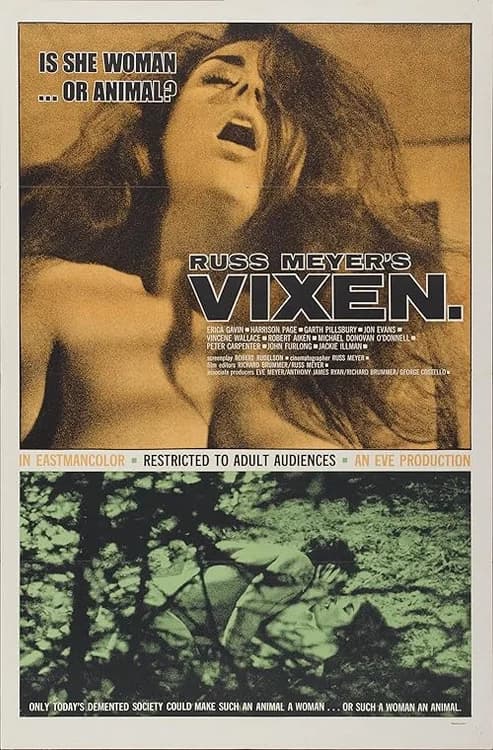
Russ Meyer's 1968 film Vixen! stands as a provocative entry in the director's filmography, blending exploitation elements with a surprisingly sharp look at social mores. The plot follows the titular Vixen (Erica Gavin), the restless wife of a Canadian bush pilot, as she unleashes her sexuality on a Mountie, a married couple, her own biker brother, and clashes with her sibling's draft-dodging Black friend. Set against the rugged wilderness, the film uses its sensational premise to explore themes of freedom, prejudice, and rebellion during the turbulent late 1960s.
Erica Gavin delivers a committed and charismatic performance, embodying the character's raw, untamed energy that drives the narrative. Meyer's direction is characteristically bold, with his signature visual style—emphasizing the film's dramatic landscapes and its star's physical presence. While often categorized as exploitation, Vixen! possesses a gritty authenticity and a subtext that critiques the hypocrisy and racial tensions of its time, making it more than mere titillation.
Viewers should watch Vixen! not just for its notorious reputation, but as a fascinating cultural artifact. It captures a specific moment in American cinema where underground filmmaking challenged mainstream conventions. The film's brisk 70-minute runtime, unflinching performances, and Meyer's unique directorial vision offer a compelling, if controversial, viewing experience for those interested in the edges of 1960s independent film.
Erica Gavin delivers a committed and charismatic performance, embodying the character's raw, untamed energy that drives the narrative. Meyer's direction is characteristically bold, with his signature visual style—emphasizing the film's dramatic landscapes and its star's physical presence. While often categorized as exploitation, Vixen! possesses a gritty authenticity and a subtext that critiques the hypocrisy and racial tensions of its time, making it more than mere titillation.
Viewers should watch Vixen! not just for its notorious reputation, but as a fascinating cultural artifact. It captures a specific moment in American cinema where underground filmmaking challenged mainstream conventions. The film's brisk 70-minute runtime, unflinching performances, and Meyer's unique directorial vision offer a compelling, if controversial, viewing experience for those interested in the edges of 1960s independent film.