About The Man Who Shot Liberty Valance
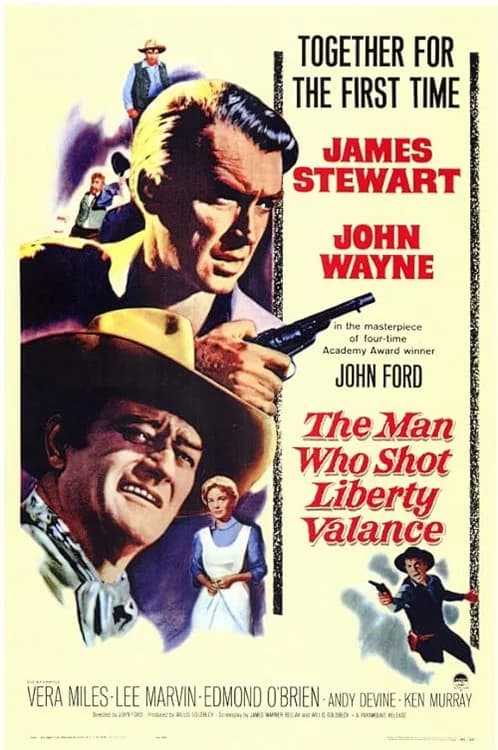
John Ford's 1962 masterpiece 'The Man Who Shot Liberty Valance' stands as one of the most thoughtful and revisionist Westerns ever made. The film follows Senator Ransom Stoddard (James Stewart) as he returns to the town of Shinbone for the funeral of Tom Doniphon (John Wayne), revealing the complex truth behind the legendary event that launched his political career. Through flashbacks, we witness Stoddard's arrival as an idealistic lawyer, his conflict with the brutal outlaw Liberty Valance (Lee Marvin), and the fateful shooting that became mythologized beyond recognition.
The performances are exceptional across the board. James Stewart brings his trademark earnestness to the role of Stoddard, while John Wayne delivers one of his most nuanced performances as the pragmatic rancher Tom Doniphon. Their contrasting approaches to justice and civilization form the film's moral core. Lee Marvin is terrifyingly effective as the sadistic Valance, creating a villain who embodies lawless brutality.
Director John Ford, working in stark black-and-white rather than his usual vibrant Technicolor, creates a film that deliberately deconstructs the Western myths he helped establish. The legendary line 'When the legend becomes fact, print the legend' encapsulates the film's central theme about how societies choose comforting myths over uncomfortable truths. This is essential viewing not just for Western fans, but for anyone interested in how history gets written and remembered. The film's exploration of civilization versus wilderness, law versus violence, and truth versus legend remains profoundly relevant today.
The performances are exceptional across the board. James Stewart brings his trademark earnestness to the role of Stoddard, while John Wayne delivers one of his most nuanced performances as the pragmatic rancher Tom Doniphon. Their contrasting approaches to justice and civilization form the film's moral core. Lee Marvin is terrifyingly effective as the sadistic Valance, creating a villain who embodies lawless brutality.
Director John Ford, working in stark black-and-white rather than his usual vibrant Technicolor, creates a film that deliberately deconstructs the Western myths he helped establish. The legendary line 'When the legend becomes fact, print the legend' encapsulates the film's central theme about how societies choose comforting myths over uncomfortable truths. This is essential viewing not just for Western fans, but for anyone interested in how history gets written and remembered. The film's exploration of civilization versus wilderness, law versus violence, and truth versus legend remains profoundly relevant today.